
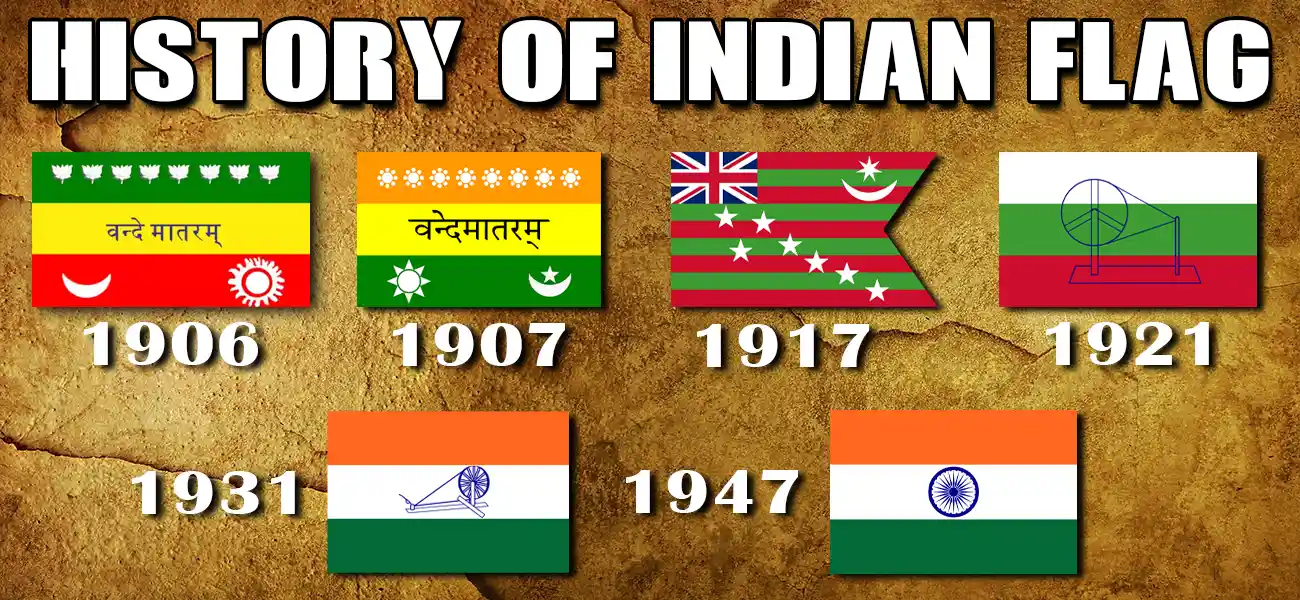
History of Indian Flag Complete List
The Indian National Flag, popularly known as the Tiranga or Tricolor, is more than a symbol of the nation. It represents India’s journey from colonial rule to freedom, unity in diversity, and its democratic spirit. The story of the Indian flag is the story of India itself—evolving over decades, shaped by the freedom struggle, and finally adopted in its current form on 22 July 1947.
This article explores the complete history of Indian flag its origins, evolution, symbolism, and significance.
Important History of Indian Flag
The Indian National Flag, popularly known as the Tiranga or Tricolor, is more than a symbol of the nation. It represents India’s journey from colonial rule to freedom, unity in diversity, and its democratic spirit. The story of the Indian flag is the story of India itself—evolving over decades, shaped by the freedom struggle, and finally adopted in its current form on 22 July 1947.
This article explores the complete history of Indian flag—its origins, evolution, symbolism, and significance.
Early Attempts at a Flag for India
The First National Flag (1906)
The first unofficial national flag was hoisted on 7 August 1906 at Parsee Bagan Square, Calcutta (now Kolkata).
It had three horizontal stripes: green (top), yellow (middle), and red (bottom).
Symbols included the sun, crescent moon, and Vande Mataram written in the center.
Though unofficial, it marked the beginning of India’s quest for a national symbol.
Madame Cama’s Flag (1907)
In 1907, Madame Bhikaji Cama unfurled a flag at the International Socialist Congress in Stuttgart, Germany.
It was similar to the 1906 design but slightly modified.
This became the first Indian flag to be hoisted on foreign soil, bringing India’s struggle to the world stage.
The Home Rule Movement Flag (1917)
During the Home Rule Movement, led by Bal Gangadhar Tilak and Annie Besant, a new flag was introduced.
It had five red and four green stripes arranged alternately.
On the top left corner was the Union Jack, and on the right side was a crescent with a star.
The flag also featured the Saptarishi constellation (seven stars).
However, the presence of the Union Jack was controversial, as it represented British rule.
Gandhi’s Flag (1921)
In 1921, Pingali Venkayya, a freedom fighter from Andhra Pradesh, presented a flag design to Mahatma Gandhi at the Indian National Congress session in Bezwada (now Vijayawada).
The flag had:
Red stripe: Hindus
Green stripe: Muslims
Later, Gandhi suggested adding a white stripe for other communities and peace.
A spinning wheel (charkha) in the center, symbolizing self-reliance (swadeshi).
This flag was widely used in the freedom movement and came closest to today’s Tiranga
The 1931 Swaraj Flag
In 1931, a resolution was passed to adopt a more universal design.
The new flag had three horizontal stripes:
Saffron at the top – Courage and sacrifice
White in the middle – Peace and truth
Green at the bottom – Prosperity and faith
Charkha in the center – Self-reliance and progress
This design was officially adopted by the Indian National Congress and became the symbol of the independence struggle.
The Present National Flag (1947)
With independence approaching, the Constituent Assembly adopted the current tricolor on 22 July 1947.
The design was based on the 1931 Swaraj flag but with one major change—the Ashoka Chakra replaced the spinning wheel.
Features of the Flag:
Three Colors (Tiranga):
Saffron (top): Courage, sacrifice, and strength
White (middle): Peace, truth, and honesty
Green (bottom): Prosperity, faith, and fertility
Ashoka Chakra (center):
A navy-blue wheel with 24 spokes, taken from the Lion Capital of Ashoka at Sarnath.
Symbolizes righteousness, motion, and progress.
This is the flag we know and respect today as the Tiranga.
The Ashoka Chakra: Symbolism
The Ashoka Chakra is one of the most important additions to the Indian flag.
Represents the cycle of time and the eternal wheel of law (Dharma).
The 24 spokes represent 24 hours of the day, reminding us that there is no stagnation in life.
Symbolizes justice, truth, and dynamism—India must always keep moving forward.
The Flag Code of India
The display and usage of the national flag are governed by the Flag Code of India, 2002.
Earlier, only government institutions were allowed to hoist the flag.
After a Supreme Court ruling (thanks to Naveen Jindal’s petition), every Indian citizen can now proudly hoist the flag at their homes, offices, or institutions—provided it is done with dignity and respect.
The flag must never touch the ground, be used as decoration, or be draped on vehicles (except official ones).
Evolution Timeline of the Indian Flag
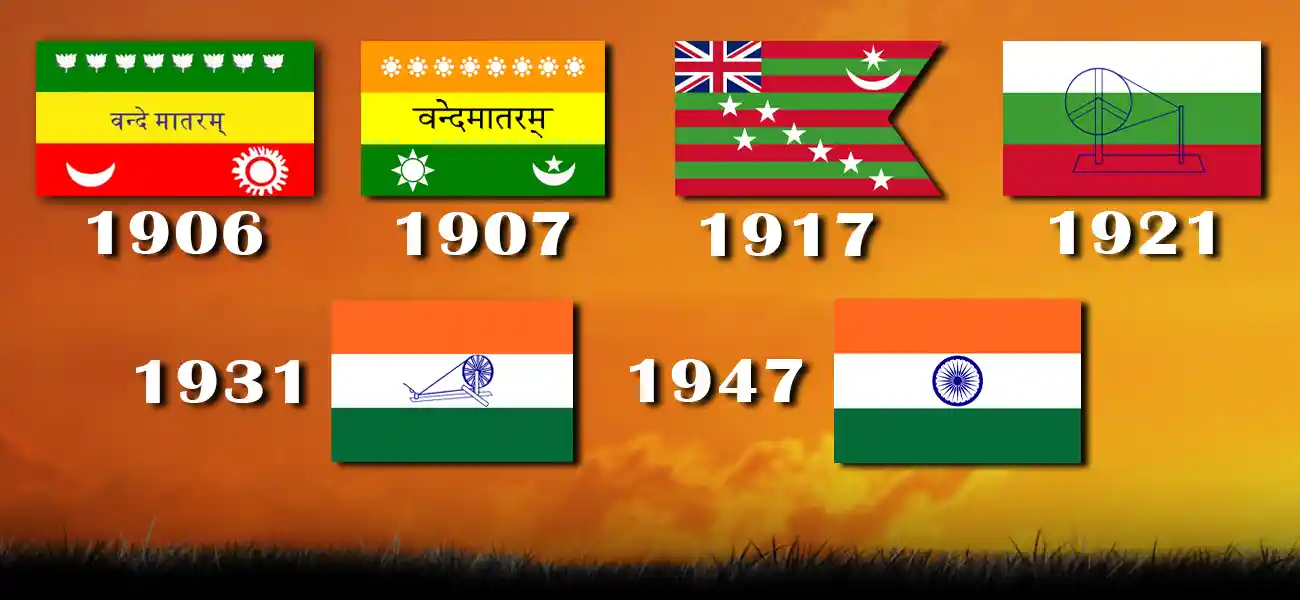
| Year | Flag Design | Key Features |
|---|---|---|
| 1906 | Calcutta Flag | Green, yellow, red stripes with sun, moon, Vande Mataram |
| 1907 | Madame Cama’s Flag | Similar to 1906, first hoisted abroad |
| 1917 | Home Rule Flag | Red & green stripes, Union Jack, Saptarishi, crescent |
| 1921 | Gandhi’s Flag | Red, white, green, spinning wheel |
| 1931 | Swaraj Flag | Saffron, white, green, spinning wheel |
| 1947 | Current Flag | Saffron, white, green with Ashoka Chakra |
The history of Indian flag is the history of India’s independence struggle. From the first attempt in 1906 to the tricolor of today, the flag has witnessed the sacrifices of freedom fighters, the rise of nationalism, and the birth of the world’s largest democracy.
Today, the Tiranga stands tall as a symbol of unity, freedom, and pride. Every time it flutters in the sky, it reminds us of our responsibility to uphold the values of justice, peace, and progress.
Also Read Ranks in indian army a guide to indian army ranks
To read more informative blogs visit www.indiandefenceacademy.in