
Military Combat Parachute System — Complete Guide
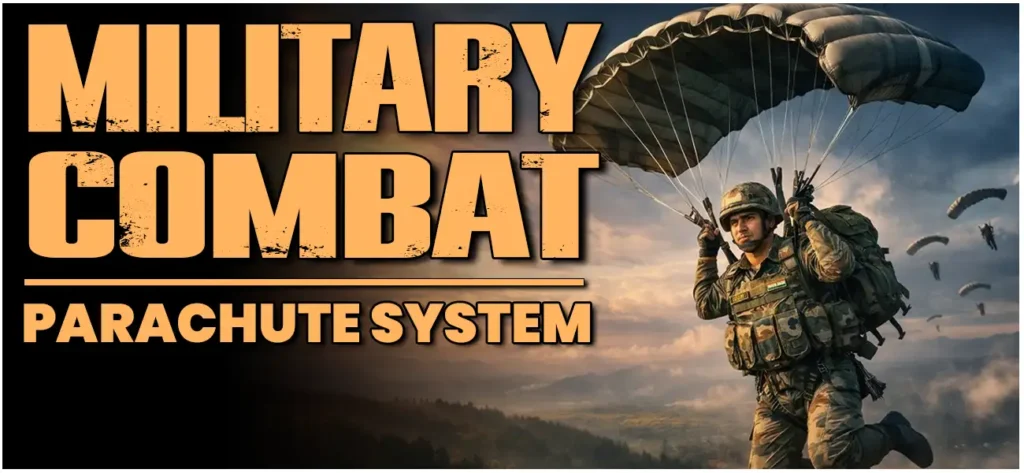
Introduction — When the Sky is the Battlefield
In modern warfare, speed, stealth, and surprise are everything. One of the most powerful tools an army has for achieving all three at once is the military combat parachute system. Whether it’s inserting special forces deep behind enemy lines in total darkness, or airdropping critical supplies to troops cut off from ground routes — the parachute remains one of the most battle-proven technologies in military history.
For NDA and defence exam aspirants, understanding airborne operations and parachute systems is not just academic knowledge — it reflects the kind of tactical awareness that makes a great officer.
What is a Military Combat Parachute System?
A military combat parachute system is a specialised set of parachuting equipment purpose-built for military operations. Unlike recreational parachutes, tactical parachute systems are purpose-built for military applications, offering a high degree of precision and control, allowing military personnel to land accurately at targeted zones, often in hostile or challenging environments. Aerodyne
Every component — from the main canopy to the harness, reserve chute, and deployment mechanism — is engineered for one goal: mission success under the most extreme conditions.
Key Components of a Military Combat Parachute System?
A standard military parachute system consists of the following parts:
1. Main Canopy — The primary parachute that slows descent. Tactical systems use round, cruciform, square or rectangular parachutes as designs are based on the mission profile. Aerodyne
2. Reserve Parachute — A backup safety chute. As a safety measure, tactical parachute systems often include a reserve parachute. Aerodyne
3. Harness & Container — Holds everything together on the soldier’s body, distributing forces evenly on deployment.
4. Automatic Activation Device (AAD) — The Electronic Automatic Activation Device (EAAD) provides a simpler and more reliable method of activation in the event the parachutist is unable to deploy the parachute at the appropriate altitude. The EAAD activates and cuts the reserve parachute closing loops if the jumper is falling at 78 mph or faster at the minimum deployment altitude. Wikipedia
5. Navigation Aid (NAVAID) — The Navigation Aid will provide in-flight navigation and mission planning capability, allowing parachutists under canopy to locate themselves and the intended drop zone easily, using a GPS that integrates with the Mission Planner of the Joint Precision Airdrop System
Types of Military Combat Parachute Systems
1. Static Line Parachute System
The most widely used system for mass troop deployment.
Static line parachutes are deployed automatically as the jumper exits the aircraft. A line connected to the aircraft pulls the deployment bag, ensuring the parachute opens immediately. Aerodyne
This is the system used by Indian Army paratroopers during mass combat jumps. It requires minimal freefall training and is ideal for rapidly deploying large numbers of troops.
Used for: Mass assault jumps, battalion-level airborne operations Aircraft: C-130 Hercules, C-17 Globemaster, IL-76
2. HALO — High Altitude Low Opening
The signature jump of special forces worldwide.
HALO and HAHO jumps are advanced airborne techniques that allow for stealth insertions from high altitudes. Aerodyne In a HALO jump, the soldier exits the aircraft at extreme altitude — sometimes above 30,000 feet — freefalls through the sky at high speed, and only opens the parachute at very low altitude, just a few hundred to a few thousand feet above the ground.
The RA-1 Military Free-Fall Advanced Ram-Air Parachute System provides a multi-mission, high-altitude parachute delivery system that allows personnel to exit at altitudes between 3,500 and 35,000 ft. Wikipedia
Why HALO? The aircraft stays at high altitude, out of radar range. The soldier is nearly invisible during freefall. By the time the chute opens, the soldier is already close to the ground — minimal time under canopy means minimal chance of detection.
Used by: Para SF (India), Special Forces, Navy SEALs, SAS Requires: Oxygen mask, specialised jumpsuit, altimeter
3. HAHO — High Altitude High Opening
The long-distance stealth insertion method.
In HAHO, the parachute opens immediately after exiting the aircraft at high altitude. Jumpers may descend for miles, requiring maximum glide and oxygen support. Aerodyne A HAHO jumper can glide 30–50 km horizontally, meaning the aircraft never needs to enter enemy airspace at all.
Hi-5 is the highest performing military freefall parachute for both HAHO and HALO missions, designed for responsive handling, safe flight characteristics, and exceptional glide performance. Airborne Systems
Used for: Deep infiltration behind enemy lines without aircraft detection Key skill: Canopy navigation, formation flying under parachute
4. Ram-Air Parachute System
The modern steerable parachute used for precision landings.
Steerable parachutes allow jumpers to guide their descent, offering improved accuracy and obstacle avoidance — especially in limited drop zones. Aerodyne
Ram-air parachutes are rectangular, inflate like a wing, and allow the parachutist to fly — not just fall. They can be steered left, right, slowed down, and landed with pinpoint accuracy. Airborne Systems designs and manufactures high-performance, truly-elliptical Ram-Air parachutes for various types of military missions, including the challenging special operations missions. Airborne Systems
Used for: Special operations, precision insertion, HALO/HAHO missions
5. Cargo Parachute System
War is not just about inserting troops — supplies, vehicles, and weapons need to reach the battlefield too.
Cargo parachutes are used for delivering supplies, equipment, and vehicles into combat or remote zones. These systems are engineered to withstand heavier weights and impact forces. Aerodyne
The US Army’s cutting-edge Rapid Rigging De-Rigging Airdrop System (RRDAS) takes this further — self-inflating airbags can be utilised as low as 750 feet above ground level and carry loads from between 5,000 and 22,000 pounds, reducing rigging time by 25% and de-rigging time by 40%, which gets soldiers out of harm’s way faster. www.army.mil
Used for: Ammunition, food, medical supplies, artillery, jeeps, helicopters
6. Tandem Parachute System
Used for training and special insertion missions where one experienced jumper controls the descent for both.
The Gemini parachute system is designed for military tandem operations, offering high carrying capacity, exceptional flight performance, and advanced glide modulation with precise control of glide ratio, ensuring smooth integration with military free fall teams. Airborne Systems
Used for: Training new jumpers, VVIP rescue extractions, observer insertions
The T-11 — India's Paratroopers & The Modern Standard
The T-11 is the current benchmark for troop parachute systems globally. The T-11 includes a completely redesigned main and reserve parachute and an integrated harness assembly. The T-11 main canopy utilises a unique deployment sequence to reduce the opening shock and canopy oscillation, and is designed to have an average rate of descent of 19 feet per second for the 95th percentile service member. Wikipedia
The T-11 system carries a paratrooper with a total exit weight of 400 lbs, minimises opening shock thanks to a unique canopy sleeve and slider allowing for canopy inflation time of about 6 seconds, and provides a slower rate of descent and zero oscillation even after lowering the combat load.
Indian Army Airborne Forces — Para SF & The Parachute Regiment
India’s elite airborne warriors are the Parachute Regiment and the Para Special Forces (Para SF). They are trained in all types of combat jumps — static line, HALO, HAHO — and are among the most feared special operations units in the world.
To become a Para SF officer, candidates must:
- Clear the NDA or CDS exam
- Complete IMA/OTA training
- Qualify gruelling Para SF selection — one of the hardest in the world
- Complete Basic Parachute Course at Agra Parachute Training School
- Complete advanced HALO/HAHO certification
This is why studying at Indian Defence Academy matters. The foundation of your journey to the Para SF starts with clearing the NDA exam — and IDA Dehradun has helped 500+ students take that first step.
HALO vs HAHO vs Static Line — Quick Comparison
| Feature | Static Line | HALO | HAHO |
|---|---|---|---|
| Exit altitude | 600–1,500 ft | 15,000–35,000 ft | 15,000–35,000 ft |
| Opening altitude | Immediate | 2,000–3,500 ft | 15,000 ft |
| Freefall time | None | 1–3 minutes | Minimal |
| Glide distance | None | Short | 30–50 km |
| Detection risk | Medium | Very low | Lowest |
| Used for | Mass assault | Stealth insertion | Deep infiltration |
| Training required | Basic | Advanced | Advanced |
Future of Military Parachute Systems
The battlefield is evolving and so is parachute technology:
- GPS-guided cargo drops — Autonomous parachutes that steer themselves to exact GPS coordinates with zero human jumpers
- Powered parachutes — Small motors attached to combat parachutes for extended range and maneuverability
- Stealth canopy materials — Radar-absorbing fabrics that make parachutes nearly invisible to enemy detection systems
- Exo-suit integration — Future systems being tested to allow soldiers to land with full powered armour intact
Final Word — The Sky is Not the Limit, It's the Beginning
Military combat parachute systems are far more than a way to get from an aircraft to the ground. They are sophisticated tactical tools that define the difference between a mission that succeeds and one that fails. From the thundering mass jump of an airborne battalion to the lone Para SF operator gliding silently into enemy territory at midnight — the parachute is at the heart of it all.
For every NDA aspirant reading this — the soldiers who use these systems were once sitting exactly where you are. Their journey started with cracking the NDA exam, just like yours can start today.