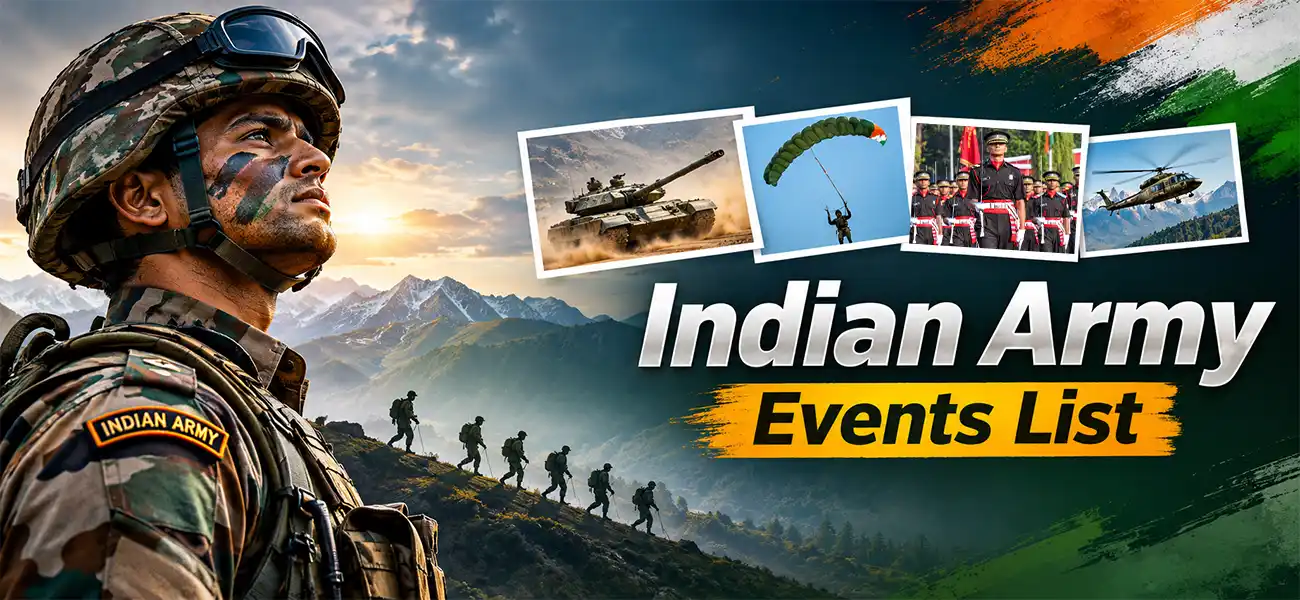
Indian Army Events List - Important Days, Dates and Military Ceremonies
The Indian Army’s calendar includes occasions that honour military service, commemorate historic victories, and recognise the contributions of different arms and services. These events help students and citizens understand the Army’s history, traditions, and responsibilities.
This Indian Army events list covers major annual observances, selected corps days, and military ceremonies. It also includes national and Armed Forces occasions in which the Army participates. These are identified separately because not every defence-related event belongs exclusively to the Indian Army.
Important Indian Army Events and Dates
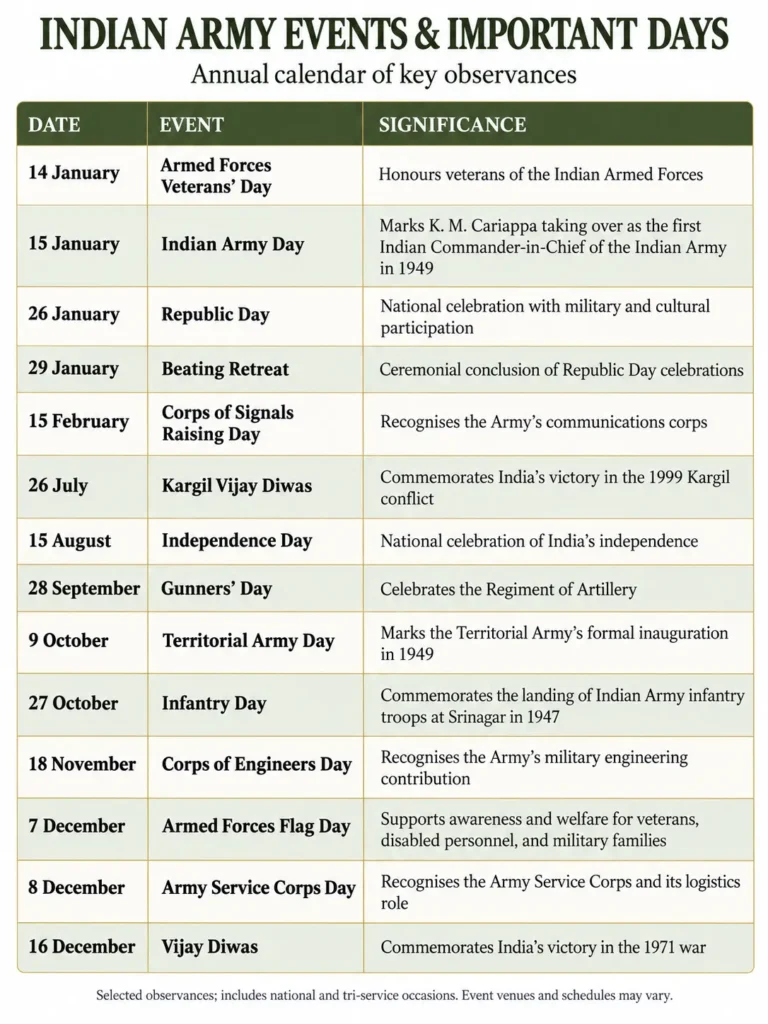
The dates above are recurring observances. Parade venues, public programmes, access arrangements, and associated activities can change each year. This is a selected list, not a complete calendar of every regiment or unit anniversary.
Indian Army Events List
1. Armed Forces Veterans’ Day — 14 January
Armed Forces Veterans’ Day honours the service and contribution of retired personnel from the Army, Navy, and Air Force.
The date marks the retirement of Field Marshal K. M. Cariappa on 14 January 1953. Observances can include veterans’ gatherings, welfare assistance, grievance-resolution facilities, and tributes to those who served.
Remember: Veterans’ Day is a tri-service occasion, rather than an Army-only event.
2. Indian Army Day — 15 January
Indian Army Day commemorates 15 January 1949, when General K. M. Cariappa, who later became a Field Marshal, took command from General Sir Francis Bucher.
The occasion recognises the professionalism, courage, and service of Army personnel. Celebrations may include a parade, military demonstrations, honours, and remembrance ceremonies.
Remember: Army Day marks the transition to an Indian Commander-in-Chief. It is not the date on which the Army was first established.
3. Republic Day and Beating Retreat — 26 and 29 January
Republic Day — 26 January
Republic Day marks the Constitution of India coming into effect in 1950. The national parade combines military participation with displays representing India’s cultural diversity.
For defence aspirants, it provides an opportunity to learn about marching contingents, military equipment, ceremonial traditions, and national institutions.
Beating Retreat — 29 January
Beating Retreat marks the formal conclusion of Republic Day celebrations. The ceremony at Vijay Chowk in New Delhi features military music and ceremonial performances.
Bands from the Army, Navy, Air Force, and Central Armed Police Forces participate, as specified in the programme for the year.
Remember: These are national ceremonies with participation from multiple services, not exclusively Indian Army events.
4. Corps of Signals Raising Day — 15 February
The Corps of Signals traces its raising to 15 February 1911.
Its role centres on military communications, enabling information to move between commanders, formations, and units. The raising day recognises the personnel responsible for supporting reliable communication across demanding operational environments.
For students, this occasion highlights that military effectiveness depends on communication and technical support as well as combat capability.
5. Kargil Vijay Diwas — 26 July
Kargil Vijay Diwas commemorates India’s victory in the 1999 Kargil conflict and honours the personnel who fought during the operation.
The occasion is associated with Operation Vijay and the courage shown in difficult high-altitude conditions. Commemorations include remembrance ceremonies, tributes to fallen personnel, and interactions with veterans and military families.
Remember: Kargil Vijay Diwas relates to the 1999 conflict. It should not be confused with Vijay Diwas on 16 December.
6. Independence Day — 15 August
Independence Day commemorates India’s independence in 1947. Flag-hoisting ceremonies and national celebrations provide an opportunity to reflect on freedom, public service, and responsibility towards the country.
The Armed Forces participate in national ceremonial arrangements. Schools and defence-coaching institutes can use the occasion for educational talks, historical presentations, and discussions about service.
Remember: Independence Day is a national observance, not an Army raising day.
7. Gunners’ Day — 28 September
Gunners’ Day celebrates the Regiment of Artillery.
The date is associated with the raising of 5 (Bombay) Mountain Battery on 28 September 1827. The occasion recognises the service and traditions of artillery personnel.
For defence aspirants, it is a useful starting point for understanding artillery’s role in supporting military operations through firepower.
8. Territorial Army Day — 9 October
Territorial Army Day commemorates the force’s formal inauguration on 9 October 1949 by C. Rajagopalachari.
The Territorial Army supports the Regular Army and undertakes roles assigned to its different units. Its history also includes contributions to ecological restoration and specialist services.
Remember: The Territorial Army Act dates to 1948, while the annual observance on 9 October is associated with its formal inauguration in 1949.
9. Infantry Day — 27 October
Infantry Day commemorates 27 October 1947, when troops of the 1st Battalion of the Sikh Regiment landed at Srinagar to help defend Jammu and Kashmir.
The day honours the courage, sacrifice, and operational contribution of infantry personnel. It is observed through tributes, remembrance ceremonies, and activities highlighting infantry history.
Remember: Infantry Day honours a particular arm of the Army and its historic action; Army Day recognises the Army as a whole.
10. Corps of Engineers Day — 18 November
Corps of Engineers Day recognises the military engineering contribution of the Army’s engineers, commonly known as Sappers.
Their work supports mobility, infrastructure, and operational requirements. Military engineering demonstrates how technical knowledge and field skills contribute to the effectiveness of a fighting force.
This observance on 18 November is distinct from India’s general Engineers’ Day on 15 September.
11. Armed Forces Flag Day — 7 December
Armed Forces Flag Day encourages public support for the welfare of ex-servicemen, disabled personnel, and military families, including the dependants of fallen personnel.
The occasion combines remembrance with practical support through the Armed Forces Flag Day Fund and related welfare efforts.
Remember: It concerns all three Armed Forces services and is not limited to the Indian Army.
12. Army Service Corps Day — 8 December
Army Service Corps Day recognises the contribution of the Army Service Corps, or ASC.
The corps provides essential logistics support, including supply and transport functions. Its work illustrates why sustaining troops is as important as deploying them.
For students studying military organisation, this occasion helps explain the relationship between combat units and supporting services.
13. Vijay Diwas — 16 December
Vijay Diwas commemorates India’s victory in the 1971 war, including the surrender of Pakistani forces in Dhaka on 16 December 1971. The war led to the emergence of Bangladesh.
The occasion honours the contribution and sacrifices of the Indian Armed Forces.
| Observance | Date | Associated Conflict |
|---|---|---|
| Kargil Vijay Diwas | 26 July | Kargil conflict, 1999 |
| Vijay Diwas | 16 December | Indo-Pakistani War, 1971 |
Remembering the date together with the conflict helps avoid a common General Knowledge mistake.
Other Indian Army Events Whose Dates Vary
Not every military event follows a fixed annual date.
Passing Out Parades
Passing Out Parades mark the completion of training at military academies. The Indian Military Academy in Dehradun is one prominent example.
Check the announcement for the relevant course before planning a visit. Public access should not be assumed; attendance depends on the academy’s arrangements and permissions.
Regimental and Unit Raising Days
Individual regiments, battalions, and units commemorate their own raising days and battle honours. These belong to their specific histories and are not necessarily observed across the entire Army.
Military Exercises
Exercises are training activities rather than commemorative days. Their schedules, locations, participants, and objectives vary by edition.
For examination preparation, record the exercise name, participating countries, location, and broad training purpose from the relevant official announcement.
Recruitment and Outreach Events
Recruitment activities, equipment displays, veterans’ rallies, and public outreach programmes follow separately announced schedules. Do not treat an old event notice as a current invitation or recruitment opportunity.
How NDA and CDS Aspirants Can Study These Events
Use a four-part revision method:
Date: When is the event observed?
Meaning: What does it commemorate?
Historical link: Which person, year, conflict, or unit is associated with it?
Scope: Is it Army-specific, tri-service, or a national occasion?
For example:
15 January → Army Day → K. M. Cariappa took command in 1949 → Indian Army.
Prepare short revision cards and revisit them regularly. Understanding the historical reason is more useful than memorising an isolated date.
Frequently Asked Questions
When is Indian Army Day celebrated?
Indian Army Day is celebrated on 15 January, marking K. M. Cariappa taking over as the first Indian Commander-in-Chief of the Indian Army in 1949.
What is the difference between Army Day and Infantry Day?
Army Day is observed on 15 January and recognises the Army as a whole. Infantry Day is observed on 27 October and commemorates the infantry landing at Srinagar in 1947.
Is Armed Forces Flag Day only for the Army?
No. Armed Forces Flag Day supports remembrance and welfare connected with the Army, Navy, and Air Force.
Do military exercises have fixed dates every year?
No. Check the official announcement for each edition rather than assuming the previous year’s dates will apply.
Can civilians attend Indian Army events?
Some events have public viewing or ticketing arrangements, while others require invitations or permission. Confirm access through the official organiser before travelling.
Also Read Best Newspaper for NDA Preparation