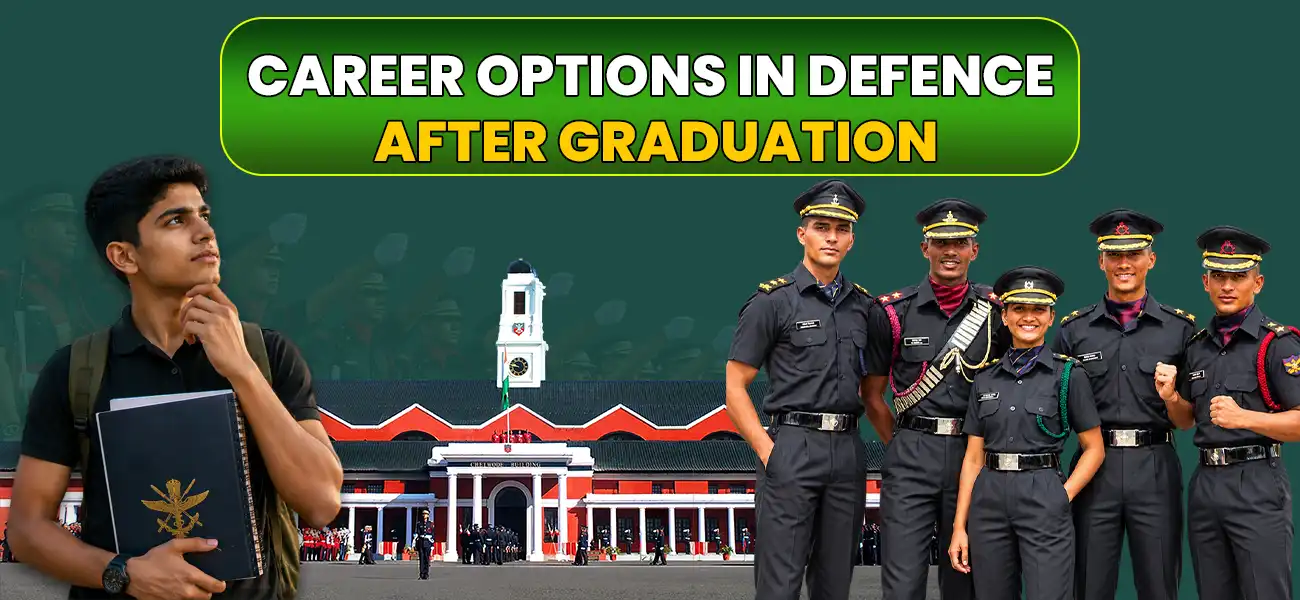
Career Options In Defence After Graduation
Lorem ipsum dolor sit amet, consectetur adipiscing elit. Ut elit tellus, luctus nec ullamcorper mattis, pulvinar dapibus leo.
Career Options In Defence After Graduation
Graduation opens several career opportunities for students who want to serve the nation through the Indian Armed Forces. Graduates from different academic backgrounds can apply for officer-level entries in the Indian Army, Indian Navy, and Indian Air Force, depending on their educational qualifications, age, and other eligibility requirements.
The major defence career options after graduation include the Combined Defence Services (CDS) Examination, Air Force Common Admission Test (AFCAT), Indian Army Technical Entry routes for eligible graduates, and other specialised entries. Candidates can also explore opportunities in the Indian Coast Guard and other defence-related organisations, depending on the recruitment notification.
This guide explains the major defence career options after graduation, their eligibility requirements, selection processes, and how to prepare for them.
1. Career Options in Defence After Graduation
Graduates can explore several entry routes to become commissioned officers in the Indian Armed Forces.
1. Combined Defence Services (CDS) Examination
The Combined Defence Services (CDS) Examination is conducted by the Union Public Service Commission (UPSC) to recruit eligible graduates for officer training through designated defence academies.
Academies and entry options:
Indian Military Academy (IMA): For eligible candidates seeking to become officers in the Indian Army.
Indian Naval Academy (INA): For candidates meeting the prescribed educational and other eligibility requirements for the relevant naval entry.
Air Force Academy (AFA): For eligible candidates seeking officer careers in the Indian Air Force.
Officers Training Academy (OTA): For eligible candidates applying for Short Service Commission routes in the Army.
Basic educational qualifications:
IMA and OTA: A recognised university degree.
INA: An engineering degree.
AFA: A degree with Physics and Mathematics at the 10+2 level, or a Bachelor of Engineering degree, subject to the applicable notification.
Candidates must also satisfy the prescribed age, marital status, nationality, and medical requirements.
Selection process:
Written examination conducted by UPSC.
Services Selection Board (SSB) interview for candidates who qualify.
Medical examination.
Final merit list and joining instructions, subject to eligibility and vacancies.
CDS is one of the main options for graduates who want to pursue an officer career in the Indian Army, Navy, or Air Force.
2. Air Force Common Admission Test (AFCAT)
The Air Force Common Admission Test (AFCAT) is a recruitment examination conducted by the Indian Air Force for eligible candidates seeking officer positions in specified branches.
Career opportunities include:
Flying Branch
Ground Duty (Technical) Branch
Ground Duty (Non-Technical) Branch
The branches available depend on the recruitment notification and the candidate’s qualifications.
Educational qualifications:
Flying Branch: Typically requires graduation with the prescribed Physics and Mathematics background at 10+2 level, or an eligible engineering qualification, along with specified marks.
Technical Branch: Usually requires an eligible engineering degree in the prescribed disciplines.
Non-Technical Branches: Requirements vary by branch and may include degrees in specified subjects, commerce, finance, or other disciplines.
Selection process:
AFCAT written examination, where applicable.
Additional testing for certain branches, such as the Engineering Knowledge Test (EKT) if specified in the notification.
AFSB interview and assessment.
Medical examination.
Final merit and selection according to vacancies and eligibility.
AFCAT is a suitable option for graduates who wish to build an officer career in the Indian Air Force.
3. Indian Army Technical Entry After Graduation
Engineering graduates may be eligible for certain technical officer-entry schemes in the Indian Army, depending on the recruitment notification.
These entries can include the Technical Graduate Course (TGC) and other notified technical schemes.
Who can apply?
Candidates with the engineering qualification and discipline specified in the notification.
Candidates who satisfy the prescribed age and other eligibility conditions.
Selection process:
Application and eligibility screening.
Shortlisting based on the criteria specified in the notification.
SSB interview.
Medical examination.
Final merit list and selection against available vacancies.
Unlike CDS, some technical entries do not require a separate written examination. The selection method must be checked in the relevant notification.
4. Indian Navy Officer Entries After Graduation
Graduates can apply for various officer-entry schemes in the Indian Navy, depending on their qualifications and the branches advertised.
Possible areas include:
Executive Branch
Engineering Branch
Electrical Branch
Education Branch
Other specialised officer branches, where notified
Engineering graduates may qualify for certain technical entries, while candidates with other degrees may be eligible for specific branches if they meet the prescribed requirements.
Selection process: Depending on the entry, candidates may be shortlisted based on academic qualifications, invited for an SSB interview or other prescribed assessment, and required to pass medical examinations.
Applicants should check official Indian Navy recruitment notices for the accepted degree, age range, gender criteria where applicable, and selection procedure.
5. Other Defence and Uniformed-Service Opportunities
Graduates may also explore opportunities beyond the main CDS and AFCAT routes.
Examples include:
Indian Coast Guard: Certain officer entries may accept graduates or candidates with specialised qualifications, depending on the post.
Defence research and technical organisations: Relevant degrees may qualify candidates for technical, scientific, engineering, or administrative positions in organisations such as DRDO, subject to recruitment rules.
Central Armed Police Forces (CAPF): UPSC conducts the CAPF (Assistant Commandants) Examination for eligible graduates seeking officer-level roles in forces such as the BSF, CRPF, CISF, ITBP, and SSB. These are central armed police forces, not branches of the Indian Armed Forces.
Other specialised defence appointments: Legal, medical, education, engineering, and other professional entries may be available to candidates with the required qualifications.
These opportunities have separate recruitment rules and should not be confused with the CDS or AFCAT selection processes.
2. Which Defence Exam Should You Choose After Graduation?
The right examination depends on your degree, subjects studied at school, age, and career interests.
| Examination or Entry | Main Career Opportunity | General Qualification |
|---|---|---|
| CDS – IMA | Indian Army officer | Recognised degree |
| CDS – OTA | Indian Army officer through the relevant Short Service Commission route | Recognised degree |
| CDS – INA | Indian Navy officer training | Engineering degree |
| CDS – AFA | Indian Air Force officer training | Prescribed Physics and Mathematics background at 10+2 or eligible engineering degree |
| AFCAT | Indian Air Force officer | Branch-specific qualifications |
| Technical Graduate Course | Indian Army technical officer | Eligible engineering degree |
| Indian Navy graduate entries | Naval officer | Degree specified for the notified branch |
| CAPF (AC) Examination | Assistant Commandant in CAPFs | Recognised degree |
Important: The table provides a general overview. Exact eligibility conditions, age limits, gender-related provisions, vacancies, and selection methods can change with each official notification.
3. Eligibility Criteria for Defence Jobs After Graduation
Although every entry has its own requirements, candidates generally need to meet the following conditions.
Educational qualification: A recognised bachelor’s degree is required for many graduate-level entries. Technical, flying, education, legal, and other specialised positions may require specific subjects or professional qualifications.
Age limit: Each examination and entry has its own prescribed age range. Candidates must calculate their eligibility using the dates and rules mentioned in the relevant notification.
Nationality: Applicants must meet the nationality requirements specified for the recruitment.
Physical and medical standards: Candidates must satisfy the medical and physical standards applicable to their chosen service and branch. Standards can differ between the Army, Navy, Air Force, and specialised entries.
Other conditions: Marital status, gender eligibility, academic marks, and other conditions may vary according to the entry.
Always read the latest official notification before applying.
4. How to Prepare for Defence Exams After Graduation
A focused preparation plan can help candidates prepare for the written examination and the subsequent selection stages.
Step 1: Choose the Right Entry
First, identify the examination that matches your educational background and career goal. For example, a graduate may consider CDS, while an engineering graduate may also explore eligible technical entries and AFCAT branches.
Step 2: Understand the Exam Pattern
Review the latest syllabus, examination structure, marking scheme, and qualifying requirements. For CDS, the subjects differ by academy and entry. AFCAT has its own examination pattern.
Step 3: Strengthen Academic Subjects
For examinations that include written tests, work on the relevant subjects, which may include English, General Knowledge, Mathematics, reasoning, or branch-specific knowledge.
Step 4: Practise Mock Tests
Solve previous-year papers and take timed mock tests to improve accuracy, time management, and familiarity with the examination format.
Step 5: Prepare for the SSB or AFSB
Written examinations are only one part of selection for many officer entries. Prepare for the Services Selection Board (SSB) or Air Force Selection Board (AFSB) assessment, which evaluates qualities such as communication, reasoning, teamwork, initiative, and suitability for service life.
Step 6: Maintain General Fitness
Develop a consistent, balanced fitness routine and healthy habits. Also familiarise yourself with the medical standards for your chosen entry.
Step 7: Follow Official Notifications
Track application dates, eligibility rules, examination dates, and selection instructions through official UPSC, Indian Army, Indian Navy, and Indian Air Force recruitment websites.
5. Is It Possible to Join the Defence Forces After Any Graduation Degree?
Yes, graduates from many academic backgrounds can apply for defence entries, provided they meet the specific eligibility requirements.
For example:
BA graduates: May be eligible for certain CDS entries and other notified graduate-level opportunities.
BSc graduates: May qualify for CDS and other entries depending on their subjects and qualifications.
BCom graduates: May be eligible for certain CDS entries and selected non-technical or administrative opportunities.
BTech/BE graduates: May qualify for technical entries and specified Army, Navy, or Air Force officer routes.
Graduates with specialised degrees: May qualify for legal, medical, education, or other professional entries when their qualifications match the requirements.
A degree alone does not guarantee eligibility. Age, subjects, marks, medical standards, and other conditions must also be satisfied.
6. Can You Join the Indian Army After Graduation Without CDS?
Yes. CDS is not the only route into the Indian Army. Eligible engineering graduates may apply through notified technical entry schemes, such as the Technical Graduate Course, when available. Other specialised entries may be open to candidates with relevant professional qualifications.
The selection procedure differs by entry. Some routes involve shortlisting followed by an SSB interview, while others may have additional assessments or specific requirements.
Candidates should confirm the latest application process and eligibility conditions from the official Indian Army recruitment website.
7. What Happens After Clearing a Defence Exam?
For officer entries, the process generally includes clearing the required examination or shortlisting stage, passing the relevant SSB/AFSB assessment, meeting medical standards, and appearing on the final merit list.
Selected candidates then receive joining instructions for the prescribed training academy or establishment. After completing the required training and other service-specific requirements, they may be commissioned into the relevant service.
Clearing a written examination alone does not guarantee final selection or commissioning.
Frequently Asked Questions (FAQs)
1. Which defence exam is best after graduation?
CDS is a major route for eligible graduates seeking officer training in the Army, Navy, or Air Force. AFCAT is another key route for eligible candidates interested in Indian Air Force officer careers. Engineering graduates may also explore technical entries. The best option depends on your qualifications and career goals.
2. Can BA students join the defence forces after graduation?
Yes. BA graduates may be eligible for certain CDS entries and other notified graduate-level opportunities if they meet the age, nationality, medical, and other prescribed requirements.
3. Can BTech students apply for defence jobs after graduation?
Yes. Eligible BTech/BE graduates can explore CDS, AFCAT branches, technical officer entries, and notified Indian Navy officer schemes. The accepted engineering disciplines and other conditions vary by entry.
4. Can girls join the defence forces after graduation?
Yes. Eligible women can apply for notified officer-entry schemes, including applicable CDS routes, AFCAT branches, and other entries open to women. Availability and eligibility depend on the official recruitment notification.
5. Is Mathematics compulsory for defence exams after graduation?
Not for every entry. Mathematics is part of the CDS written examination for IMA, INA, and AFA, while the OTA written examination has a different subject structure. AFCAT and other entries have their own requirements. Candidates should check the latest syllabus and eligibility criteria for their chosen route.
6. Is the SSB interview compulsory for defence officer entries?
SSB or the relevant service selection assessment is a major stage for many officer-entry schemes. However, procedures vary by recruitment route, so candidates should follow the applicable notification.
7. Can I prepare for defence exams while completing graduation?
Yes. Students can begin by studying the relevant syllabus, practising previous-year papers, improving communication skills, maintaining fitness, and monitoring their age eligibility and application dates.
Also Read What Happens After Graduation From NDA