
Career in Defence After Engineering
Career in Defence After Engineering: Opportunities, Eligibility, Exams & Entry Routes
An engineering degree can open several career opportunities in the Indian Armed Forces. For engineering graduates who want to combine their technical knowledge with leadership, discipline and a career in uniform, there are multiple pathways to explore.
A career in defence after engineering is not limited to one particular service or examination. Depending on their engineering branch, age, gender, academic performance and other eligibility conditions, graduates can explore opportunities in the Indian Army, Indian Navy and Indian Air Force.
This guide explains the major defence jobs after engineering, important entry routes, eligibility requirements, selection processes and preparation strategies.
Why Choose a Defence Career After Engineering?
Engineering develops problem-solving, analytical thinking and technical skills. These qualities can be valuable in several roles within the Armed Forces.
A defence career can offer opportunities to:
- Work in technically challenging environments
- Lead teams and manage responsibilities
- Apply engineering knowledge to real-world situations
- Develop leadership and decision-making skills
- Serve the country
- Work with advanced defence technology
- Experience a structured and disciplined professional environment
For an engineering graduate interested in both technology and leadership, the Armed Forces can provide a different career path from conventional engineering jobs.
Defence Jobs After Engineering
Engineering graduates can explore different routes depending on their eligibility and preferred service.
Some major pathways include:
- UPSC CDS Examination
- Engineering-based technical entries in the Indian Army
- Indian Navy engineering and technical entries
- Indian Air Force technical entries
- AFCAT
- NCC Special Entry, where applicable
- Other technical and specialised recruitment schemes notified by the Armed Forces
The availability of a particular entry can change, so candidates should always check the latest official recruitment notification.
1. Indian Army After Engineering
The Indian Army offers several opportunities for engineering graduates.
CDS Entry
Engineering graduates can apply for eligible CDS entries if they satisfy the prescribed conditions.
Through the CDS examination, candidates can compete for officer-entry opportunities in the Indian Army. The selection process generally includes:
Written Examination → SSB Interview → Medical Examination → Final Merit
The exact eligibility and available vacancies depend on the particular CDS notification.
Why Consider CDS After Engineering?
CDS can be an attractive option for graduates who want to enter the Armed Forces as officers while making use of their graduate-level education.
2. Technical Entry in the Indian Army
Engineering graduates can also explore technical officer-entry opportunities in the Indian Army.
Technical entries are designed for candidates with specified engineering qualifications and branches.
Depending on the particular entry, candidates may be shortlisted based on academic performance and then called for the SSB interview.
A typical pathway can be:
Engineering Qualification → Shortlisting → SSB Interview → Medical Examination → Merit → Training
The exact engineering streams, percentage requirements, age limits and selection procedure vary according to the recruitment notification.
3. Indian Navy After Engineering
Engineering graduates can explore several opportunities in the Indian Navy, particularly in technical and engineering-related roles.
Depending on the entry and notification, opportunities may be available in areas associated with:
- Engineering
- Electrical systems
- Electronics
- Information technology
- Naval technology
- Operations and technical support
The Navy’s technical branches allow engineering graduates to apply their technical education in a military environment.
Candidates should check the latest Indian Navy recruitment notifications for available branches, engineering disciplines and eligibility requirements.
4. Indian Air Force After Engineering
Engineering graduates can also pursue a career in the Indian Air Force.
One of the important routes is the Air Force Common Admission Test (AFCAT) for eligible candidates.
Engineering graduates, particularly those from relevant technical disciplines, may be eligible for technical branch opportunities depending on the entry requirements.
AFCAT-related selection can involve:
Written Examination → Further Selection/Assessment → Medical Examination → Merit
The exact selection stages and eligibility depend on the entry and current notification.
5. AFCAT for Engineering Graduates
The AFCAT examination provides an important pathway for graduates seeking a career in the Indian Air Force.
Engineering graduates should carefully check the educational requirements for the branch they want to apply for.
AFCAT preparation generally involves areas such as:
- English
- General Awareness
- Numerical Ability
- Reasoning
- Military aptitude-related areas, as applicable
Technical candidates should also understand the additional requirements applicable to their particular branch.
6. NCC Special Entry
Engineering graduates who have an NCC background may also have opportunities through applicable NCC officer-entry schemes.
The eligibility requirements can include specific NCC qualifications, certificates, academic conditions and other requirements.
The selection process generally involves shortlisting followed by SSB and medical assessment, depending on the entry.
Candidates should verify the current notification for the exact requirements.
Which Engineering Branches Are Useful for Defence Careers?
Different defence entries may specify different engineering disciplines.
Commonly relevant engineering backgrounds can include:
- Mechanical Engineering
- Electrical Engineering
- Electronics & Communication Engineering
- Computer Science Engineering
- Information Technology
- Civil Engineering
- Aerospace/Aeronautical Engineering
- Electronics Engineering
- Other engineering disciplines specified in particular notifications
There is no universal list that applies to every defence entry. The accepted engineering branches can differ between the Army, Navy, Air Force and individual recruitment schemes.
Therefore, candidates should always compare their engineering branch with the specific qualification requirements mentioned in the current notification.
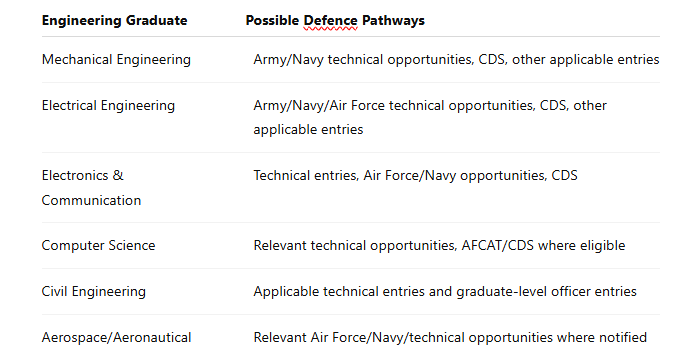
Defence Career After B.Tech
A B.Tech graduate can explore several defence career options, depending on their branch and eligibility.
For example:
Defence Exams After Engineering
Engineering graduates can consider several defence examinations and recruitment routes.
CDS
The Combined Defence Services Examination conducted by UPSC is a major graduate-level officer-entry examination.
AFCAT
The Air Force Common Admission Test is an important route for eligible graduates seeking opportunities in the Indian Air Force.
Technical Entries
The Army, Navy and Air Force periodically announce technical recruitment opportunities for candidates with specific engineering qualifications.
NCC Entry
Eligible NCC candidates may have additional officer-entry opportunities depending on the current recruitment notification.
Selection Process for Defence Jobs After Engineering
The selection process depends on the entry, but officer recruitment commonly involves several stages.
Written Examination
For entries such as CDS and AFCAT, candidates may first need to qualify a written examination.
The examination tests areas such as:
- General awareness
- English
- Mathematics or numerical ability
- Reasoning
- Other subjects specified for the particular examination
SSB Interview
The Services Selection Board (SSB) assessment evaluates candidates through multiple activities.
It may include:
- Screening tests
- Psychological assessments
- Group Testing Officer (GTO) tasks
- Personal Interview
- Conference
Candidates are assessed on various qualities relevant to officer selection.
Medical Examination
Candidates who reach the medical stage must meet the prescribed medical standards for the respective service and entry.
Final Merit
Final selection depends on the applicable merit, vacancies, medical fitness and other conditions specified by the recruiting authority.
Skills That Help Engineers in Defence Careers
An engineering background provides technical knowledge, but a successful defence career requires more than academics.
Engineers aspiring to join the Armed Forces should develop:
Leadership
Learn to take responsibility and guide a team towards a common objective.
Communication
The ability to explain ideas clearly and listen to others is important in professional and military environments.
Problem-Solving
Engineering already develops analytical thinking. Candidates should learn to apply this ability to practical and unfamiliar situations.
Physical Fitness
A defence career requires candidates to maintain an appropriate level of physical fitness.
General Awareness
Stay informed about national security, defence developments, technology, geopolitics and important current affairs.
Teamwork
Military service involves working closely with people from different backgrounds. Cooperation and team spirit are essential.
How to Prepare for a Defence Career After Engineering
Engineering students can begin preparing before graduation rather than waiting until they complete their degree.
Step 1: Understand Your Eligibility
Check:
- Age
- Engineering branch
- Academic percentage
- Gender eligibility
- Nationality
- Marital status, where applicable
- Physical and medical requirements
Step 2: Select the Right Entry
Do not prepare for every examination without a plan. Identify whether your profile is better suited to:
- CDS
- AFCAT
- Army technical entries
- Navy technical entries
- NCC entry
- Other applicable recruitment schemes
Step 3: Build Written Exam Preparation
If your selected entry requires a written examination, create a structured study plan and practise previous-year papers.
Step 4: Start SSB Preparation Early
Work on:
- Communication
- Current affairs
- Group discussion
- Reasoning
- Teamwork
- Leadership
- Decision-making
- Confidence
Step 5: Maintain Physical Fitness
Regular exercise, sports and healthy lifestyle habits can help candidates prepare for the physical demands of defence selection and training.
Engineering vs Defence Career: Which Should You Choose?
There is no single answer for every engineering graduate.
A conventional engineering career may offer opportunities in industries such as technology, manufacturing, construction, software, research and consulting.
A defence career offers a different professional environment involving:
- Leadership
- Military responsibilities
- Technical work
- Team management
- Discipline
- National service
- Operational responsibilities
Engineering graduates should consider their interests, strengths and long-term goals before choosing a career path.
Frequently Asked Questions About Career in Defence After Engineering
Can I join the Indian Army after engineering?
Yes. Engineering graduates can explore graduate-level and technical officer-entry opportunities, subject to the eligibility conditions of the particular entry.
Can I join the Indian Navy after B.Tech?
Yes. Eligible B.Tech graduates can apply for relevant Navy technical and officer-entry opportunities when vacancies are notified.
Can engineers join the Indian Air Force?
Yes. Engineering graduates can explore applicable Air Force entries, including AFCAT and technical opportunities, depending on their qualification and eligibility.
Which engineering branch is best for defence?
There is no single “best” engineering branch for defence. The useful branch depends on the particular recruitment entry and its notified engineering-discipline requirements.
Can I join defence after B.Tech without an engineering job?
Yes. Candidates do not necessarily need prior work experience in an engineering company to apply for many graduate-level defence entries. Eligibility depends on the specific recruitment notification.
Is CDS suitable for engineering graduates?
Yes. Engineering graduates who meet the eligibility requirements can apply for relevant CDS entries.
Is AFCAT suitable for engineers?
Yes. Eligible engineering graduates can apply for applicable AFCAT branches, including technical opportunities where their engineering discipline meets the prescribed requirements.