
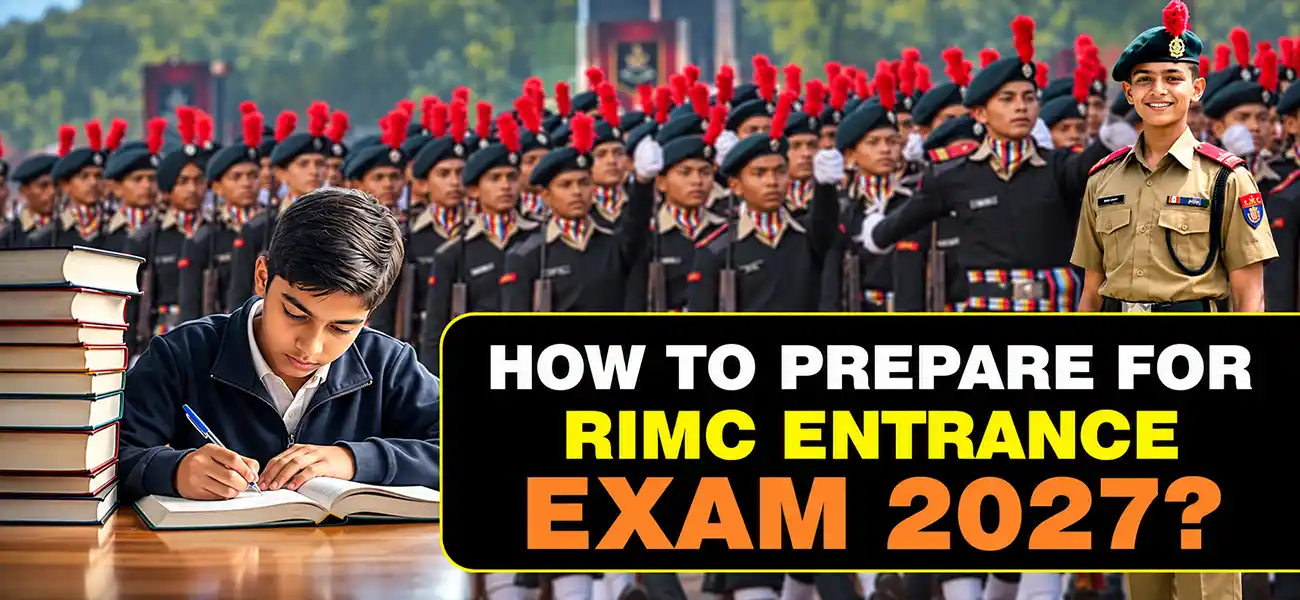
How to Prepare for RIMC Entrance Exam 2027?
The Rashtriya Indian Military College (RIMC), Dehradun is a Ministry of Defence Category-A establishment known for combining academic education with physical training, discipline, character building and leadership development. RIMC admissions are made to Class VIII, and candidates go through a selection process involving a written examination, viva-voce and medical examination.
If you are targeting the RIMC Entrance Exam 2027, starting preparation early can make a significant difference. The aim should not be simply to pass the written test, but to develop strong fundamentals, accuracy, confidence and the overall skills needed for the later stages of selection.
Important: Exact dates, eligibility conditions, syllabus details, vacancies and other requirements can vary by admission term. Candidates should always check the latest RIMC notification before applying.
RIMC Entrance Exam 2027: Selection Process
The RIMC selection process broadly consists of three stages:
- Written Examination
- Viva-Voce
- Medical Examination
Candidates who qualify the written examination are called for the viva-voce, and candidates who qualify the subsequent stage undergo medical examination. The official RIMC admission information states that admissions are to Class VIII and candidates must be studying in or have passed Class VII from a recognised school at the time of admission.
RIMC Entrance Exam Pattern
Recent RIMC admission notifications have included three written papers:
| Subject | Marks | Main Focus |
|---|---|---|
| Mathematics | 200 | Concepts, calculations and problem-solving |
| English | 125 | Grammar, vocabulary, comprehension and language skills |
| General Knowledge | 75 | General awareness and important developments |
Recent official admission information has specified 50% as the minimum qualifying level in each written paper, so preparation should be balanced across all subjects rather than focusing only on one area.
The exact pattern and qualifying requirements for the 2027 admission term should be confirmed from the relevant official notification when released.
How to Start RIMC Preparation for 2027
Understand the Syllabus First
Before beginning serious preparation, understand what you need to study.
Make three separate sections in your preparation plan:
- Mathematics
- English
- General Knowledge
Then divide each subject into smaller topics.
For example:
Mathematics
- Number system
- Fractions and decimals
- Percentage
- Ratio and proportion
- Average
- Profit and loss
- Time and work
- Geometry
- Mensuration
- Algebra
- Data interpretation
English
- Grammar
- Vocabulary
- Sentence formation
- Comprehension
- Synonyms and antonyms
- Spelling
- Basic writing skills
General Knowledge
- Indian history
- Geography
- Science
- Civics
- Sports
- Important national and international events
- General awareness
Use the latest RIMC prospectus/notification as the final reference for the syllabus.
2. Build Strong Mathematics Fundamentals
Mathematics carries the highest weight among the written papers, so it deserves consistent attention.
Instead of simply memorising formulas, focus on understanding why and how a method works.
Recommended approach:
Step 1: Learn the concept
Step 2: Solve basic questions
Step 3: Move to application-based questions
Step 4: Practise timed questions
Step 5: Review mistakes
Keep a small formula and mistake notebook. Whenever you make an error, write down the reason and the correct approach.
This helps prevent the same mistake from being repeated.
3. Improve English Every Day
English preparation should be a continuous process rather than something left for the final few weeks.
Spend some time every day on:
- Reading comprehension
- Grammar
- Vocabulary
- Sentence correction
- Synonyms and antonyms
- Spelling
- Reading and understanding passages
A simple habit is to read age-appropriate English material regularly and note down unfamiliar words.
Do not try to learn hundreds of words at once. Consistent vocabulary building is more effective than last-minute memorisation.
4. Develop General Knowledge
General Knowledge can cover a wide range of topics, so preparation should be systematic.
Focus on:
Static GK
- History
- Geography
- Indian polity
- Basic science
- Important national institutions
- Sports
- Important personalities
- National symbols
Current Affairs
Follow important developments related to:
- India
- Defence and national security at an age-appropriate general-awareness level
- Sports
- Science and technology
- Important national events
- Major international developments
Maintain a monthly GK notebook rather than trying to revise everything from one large source at the end.
5. Practise Previous-Year Papers
Previous-year papers are extremely useful because they help students understand the level and style of questions.
While solving them:
- Attempt the paper under timed conditions.
- Avoid checking answers during the test.
- Mark questions you could not solve.
- Analyse mistakes afterward.
- Identify weak topics.
- Revisit those topics before attempting another paper.
The objective is not merely to count your marks. Your mistakes tell you what needs improvement.
6. Take Regular Mock Tests
Mock tests should become a regular part of your preparation as the examination approaches.
A good progression can be:
Early preparation: Topic-wise tests
↓
Middle stage: Subject-wise tests
↓
Later stage: Full-length mock papers
↓
Final stage: Timed examination simulation
After every mock test, spend time analysing:
- Incorrect answers
- Unattempted questions
- Time-consuming questions
- Careless mistakes
- Weak topics
This analysis is often more valuable than simply taking another test.
7. Prepare for the Viva-Voce
Clearing the written examination is only one part of the selection process.
The RIMC selection process also includes a viva-voce, where candidates’ communication, personality and confidence are assessed. Official RIMC information describes the viva as a stage for assessing qualities such as intelligence, personality and communication skills.
Students should therefore develop the habit of:
- Speaking clearly
- Listening carefully
- Answering honestly
- Expressing their thoughts confidently
- Staying aware of their surroundings
- Reading regularly
- Participating in school activities
The goal should be natural confidence, not memorised answers.
8. Maintain Physical Fitness
RIMC is not purely an academic environment. The college itself emphasises physical training, sports, discipline and character development.
Students should maintain a healthy, age-appropriate routine that includes:
- Regular outdoor games
- Basic physical activity
- Running or walking as appropriate
- Stretching and mobility
- Adequate sleep
- Balanced nutrition
Do not follow extreme fitness routines. At this age, consistent activity, proper rest and healthy habits are more important.
Candidates who progress to the medical stage must meet the applicable medical standards.
8. Maintain Physical Fitness
RIMC is not purely an academic environment. The college itself emphasises physical training, sports, discipline and character development.
Students should maintain a healthy, age-appropriate routine that includes:
- Regular outdoor games
- Basic physical activity
- Running or walking as appropriate
- Stretching and mobility
- Adequate sleep
- Balanced nutrition
Do not follow extreme fitness routines. At this age, consistent activity, proper rest and healthy habits are more important.
Candidates who progress to the medical stage must meet the applicable medical standards.
9. Follow a Consistent Daily Study Routine
A realistic routine is better than studying for very long hours for a few days and then losing consistency.
Sample RIMC Preparation Routine
| Time | Activity |
|---|---|
| Morning | School preparation + short revision |
| After School | Rest and lunch |
| Afternoon | Mathematics |
| Evening | Outdoor activity/sports |
| Evening | English |
| Night | General Knowledge |
| Before Sleep | Quick revision |
Students should adjust this schedule according to their school timetable and individual needs.
10. Use a 6-Month Preparation Strategy
If you have around six months before the examination, divide your preparation into phases.
Phase 1: Foundation
Months 1–2
- Complete basic concepts.
- Strengthen Mathematics fundamentals.
- Improve grammar.
- Start regular reading.
- Build basic GK knowledge.
Phase 2: Practice
Months 3–4
- Increase question-solving practice.
- Start previous-year papers.
- Take subject-wise tests.
- Maintain an error notebook.
- Improve speed and accuracy.
Phase 3: Examination Practice
Month 5
- Start full-length mock tests.
- Practise time management.
- Revise weak areas.
- Increase question-solving speed.
Phase 4: Final Revision
Month 6
- Revise important concepts.
- Review formulas and vocabulary.
- Revise GK notes.
- Take regular mock tests.
- Avoid starting large new topics at the last moment.
Common Mistakes to Avoid
Many students lose marks not because they lack ability, but because their preparation is inconsistent.
Avoid these mistakes:
Studying only Mathematics
All written papers matter.
Leaving GK for the final month
GK requires continuous revision.
Taking mock tests without analysing them
A test is useful only when you learn from your mistakes.
Memorising without understanding
Strong concepts make unfamiliar questions easier to handle.
Ignoring physical activity
RIMC education includes physical training and overall development.
Preparing only for the written exam
The selection process also includes viva-voce and medical examination.
How Parents Can Support RIMC Aspirants
Parents play an important role in maintaining a healthy preparation environment.
They can help by:
- Providing a regular study routine
- Encouraging reading habits
- Monitoring progress without excessive pressure
- Ensuring adequate sleep and nutrition
- Encouraging outdoor activities
- Discussing mistakes constructively
- Supporting consistent preparation
The objective should be to help the child become confident, disciplined and independent, rather than creating unnecessary examination pressure.
RIMC Preparation: Key Points to Remember
For a successful RIMC preparation strategy:
Strong fundamentals + daily practice + regular revision + mock tests + communication skills + healthy physical activity = better preparation
Start early, remain consistent and track your progress.
Most importantly, don’t measure your preparation only by the number of hours studied. Measure it by what you understand, what you can solve and how consistently you improve.
Preparing for the RIMC Entrance Exam 2027 is a long-term process. A student who develops strong academic fundamentals, reads regularly, practises consistently and builds confidence step by step will be better prepared for the selection process.
RIMC itself places emphasis on academic excellence, physical training and character building, so preparation should go beyond simply solving examination questions.
Start early. Stay consistent. Learn from every mistake. And prepare with confidence.
Frequently Asked Questions
What is the RIMC Entrance Exam?
The RIMC Entrance Examination is the selection examination for admission to Class VIII at Rashtriya Indian Military College, Dehradun.
Which subjects should I prepare for RIMC?
The written examination has included Mathematics, English and General Knowledge. Candidates should check the latest notification for the applicable examination pattern.
Is Mathematics important for RIMC?
Yes. Mathematics has carried the highest marks in the recent pattern, so students should give it consistent attention.
Is there an interview after the written examination?
Yes. Candidates who qualify the written examination are called for the viva-voce.
Is there a medical examination?
Yes. Candidates who progress through the earlier stages undergo medical examination, and medical fitness is required for admission.
When should I start preparing for RIMC 2027?
Starting 6–12 months before the examination gives students sufficient time to build fundamentals, practise questions, take mock tests and prepare for the viva-voce.
Where can I check the official RIMC admission information?
Candidates should refer to the official Rashtriya Indian Military College website and the latest admission notification for the applicable term.